
How Battle Mechanics Go Beyond Bigger Numbers
Making Games with AI · Part 11
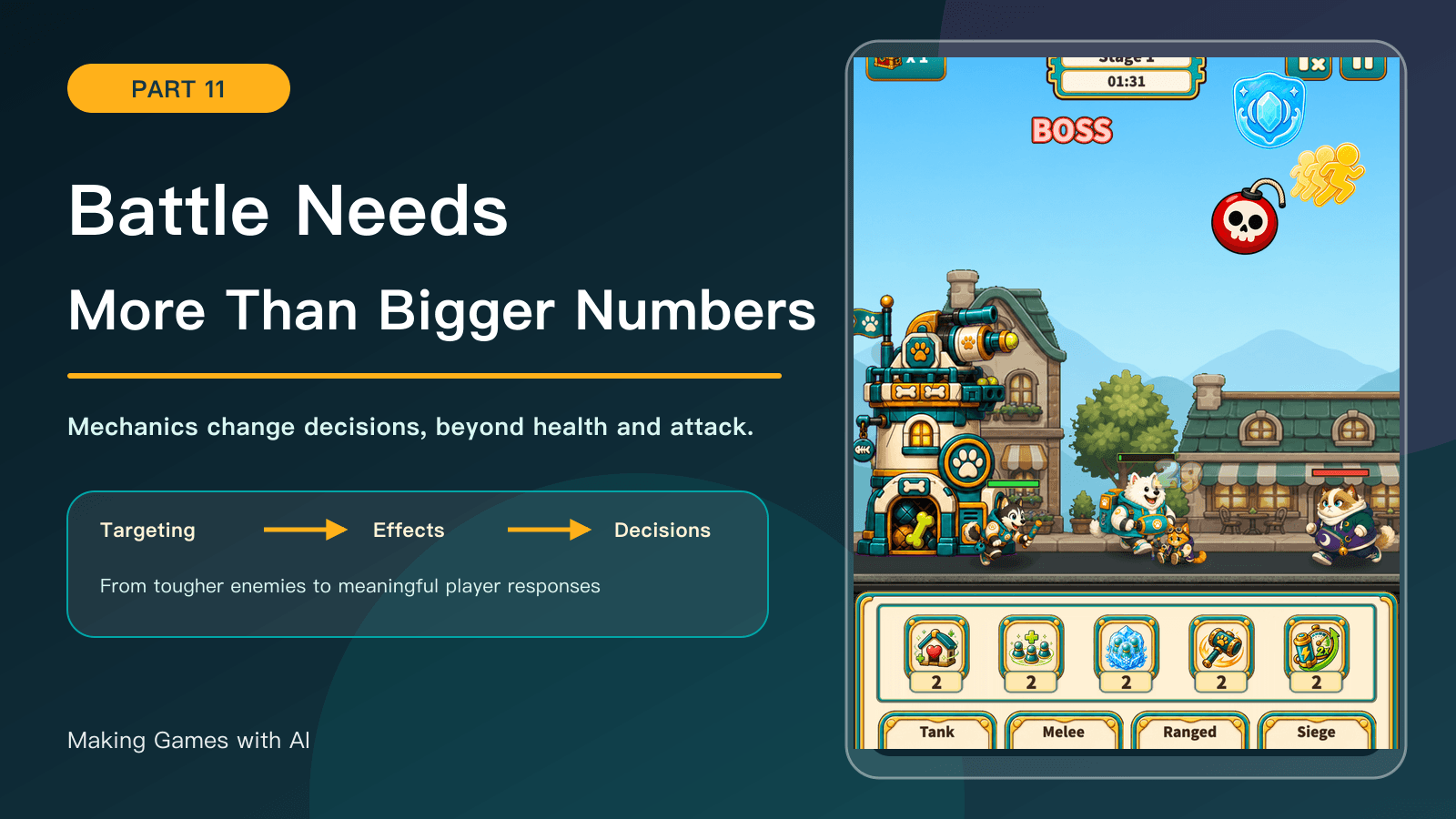
This article revisits development in June–July 2026 and early August, using records through August 2, 2026. References to “current” behavior, values, images, candidates, and validation describe that historical snapshot, not today's released game.
Previous: Why Balance Needs More Than Playtesting
The previous simulations revealed stages whose win rate and duration remained outside their targets even after increasing upgrades. Lowering enemy health could improve those numbers without making the battles more interesting.
More health or attack mostly lengthens or shortens the same encounter. A mechanic should change the player's questions: which enemy needs attention first, when danger will arrive, whether to summon now or save energy, and whether an item should protect the base, stabilize the front, or wait for another pressure peak.
This work connected targeting, effects, timing, warnings, bosses, and battle items. Each part needed a clear answer to what meaningful decision it added. The examples below describe the August 2, 2026 rules.
Mechanics begin with targeting
The first mechanism was deciding whom a unit attacked. Unclear rules could make units turn unexpectedly, projectiles switch targets, or attacks keep hitting a building while enemies approached. Balance changes could not explain behavior the player could not read.
At the beginning of a new attack cycle, Kibble Street TD prioritized enemy units in range, then the enemy tower, then the base. Within a target type it preferred the nearest target, with randomness resolving equal distances.
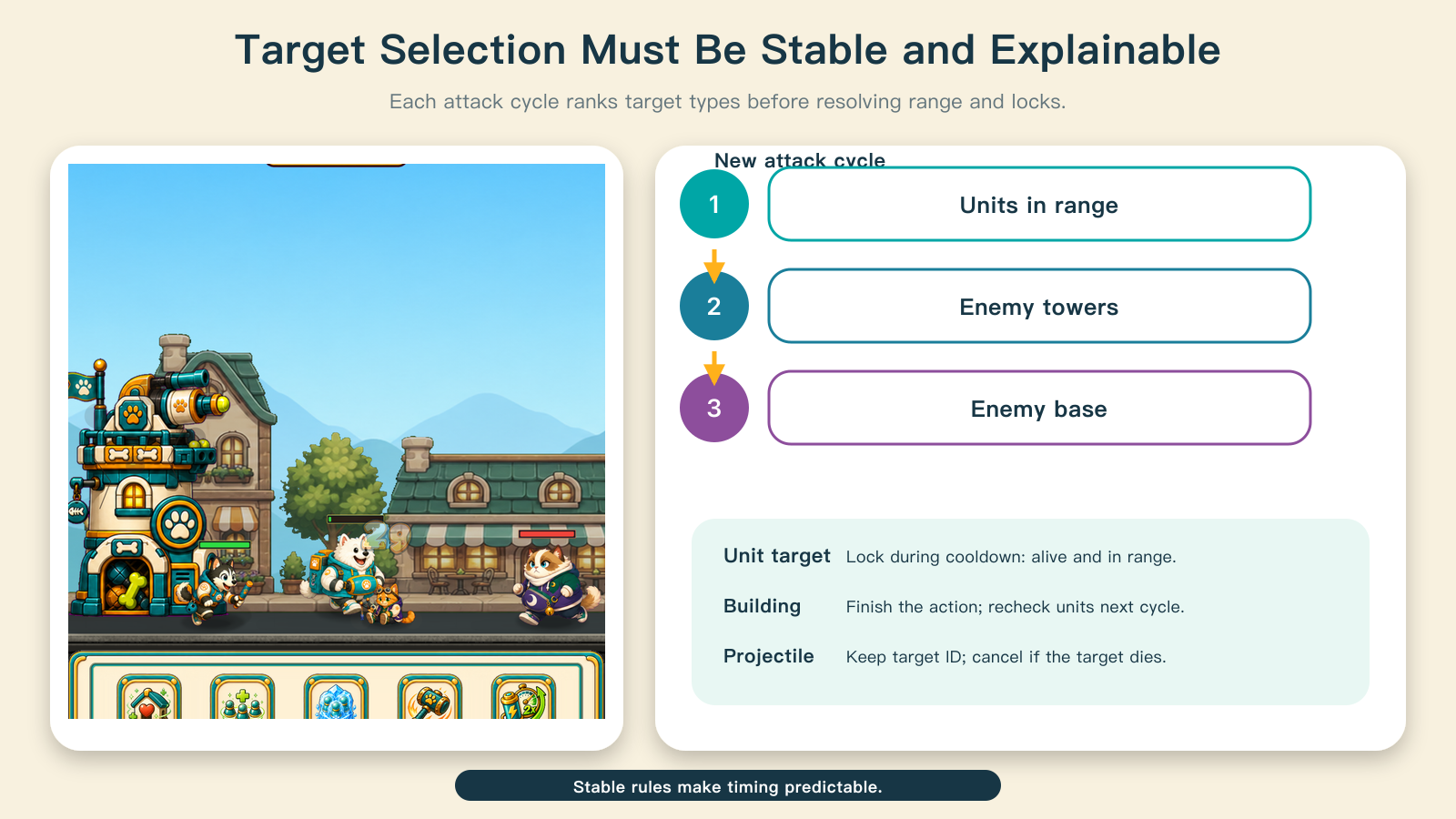
A living unit target that remained in range stayed locked during cooldown; a slightly nearer newcomer did not trigger constant switching. An attack already underway against a building completed before a newly arrived unit could enter the next selection cycle. A projectile retained its target, updated its destination as that target moved, and canceled its hit if the target died first.
These unglamorous rules made positioning, summoning time, and front-to-back relationships predictable enough for further mechanics to work.
Seven effects use one common language
The game then used seven effects: health boost, attack boost, defensive shield, fast rush, extended range, self-destruct, and movement slow. They shared levels 1–10, with level 5 as a reference, instead of using seven unrelated calculation systems.
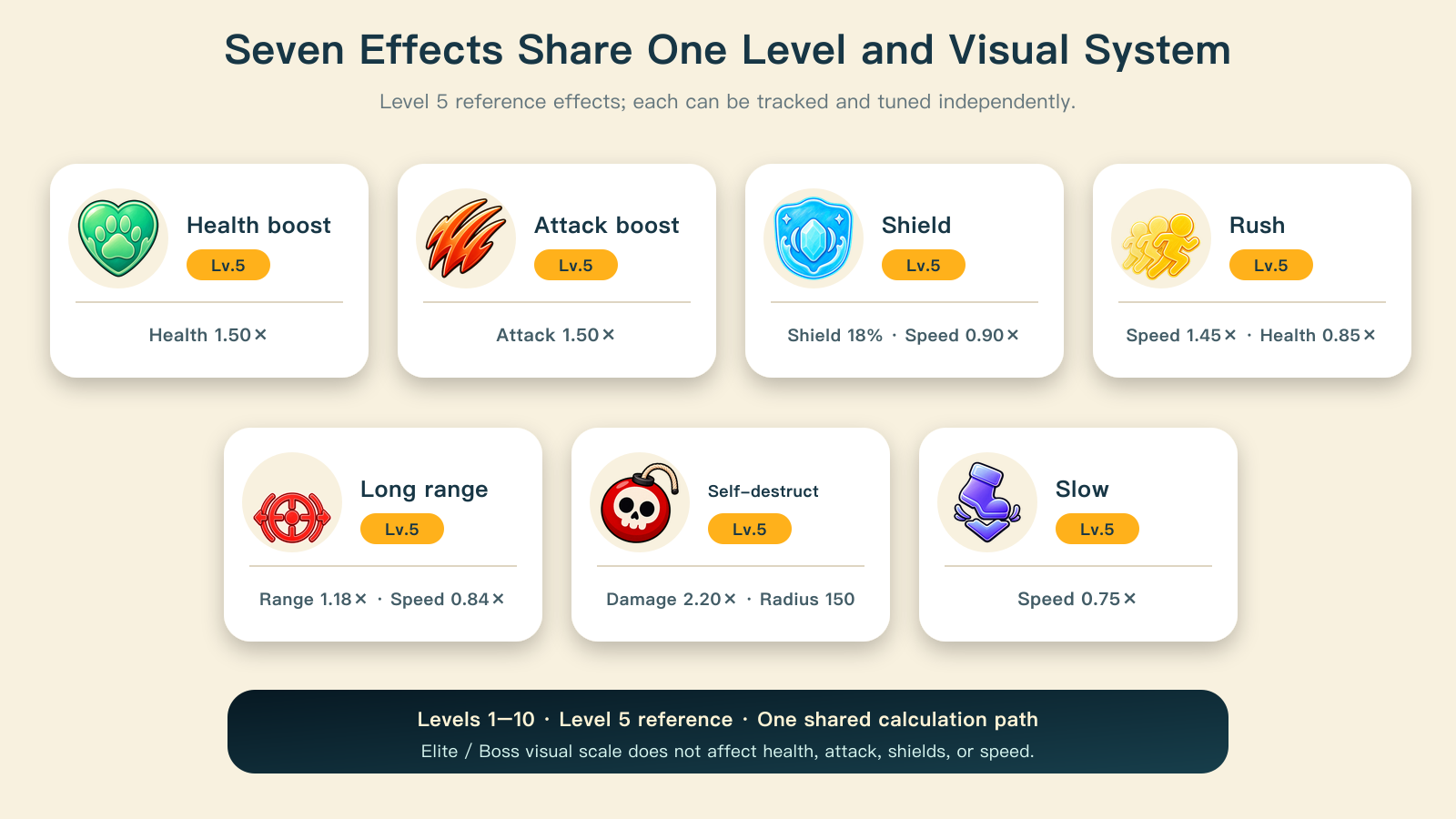
At level 5, health and attack boosts each supplied a 1.5 multiplier. Defensive shield combined an 18% shield with a small health increase and a speed cost. Fast rush traded health for 1.45 movement speed. Extended range sacrificed health and movement speed. Self-destruct units were more fragile and faster, then dealt attack-based damage within a radius of 150 on death. Movement slow helped control the strength of combinations.
Normal, elite, and boss rank controlled display scale and icon size. Actual health, attack, shields, and speed came from explicit effects. Enlarging a character therefore did not secretly increase its statistics, and balance changes could be traced to the relevant source.
Introduce mechanics in a learning sequence
Even individually clear mechanics become noise when introduced together. Players who see shields, rushes, long range, and self-destruct at once may learn only that enemies suddenly became stronger.
The historical first twenty stages introduced fast rush at Stage 3 and shield at Stage 5. Stage 8 combined shield, ranged pressure, and rush at different times. Stage 10 provided the first boss combination. Ordinary stages after Stage 11 allowed recovery before shield returned at 13, ranged pressure at 15, self-destruct at 18, and another boss at 20.
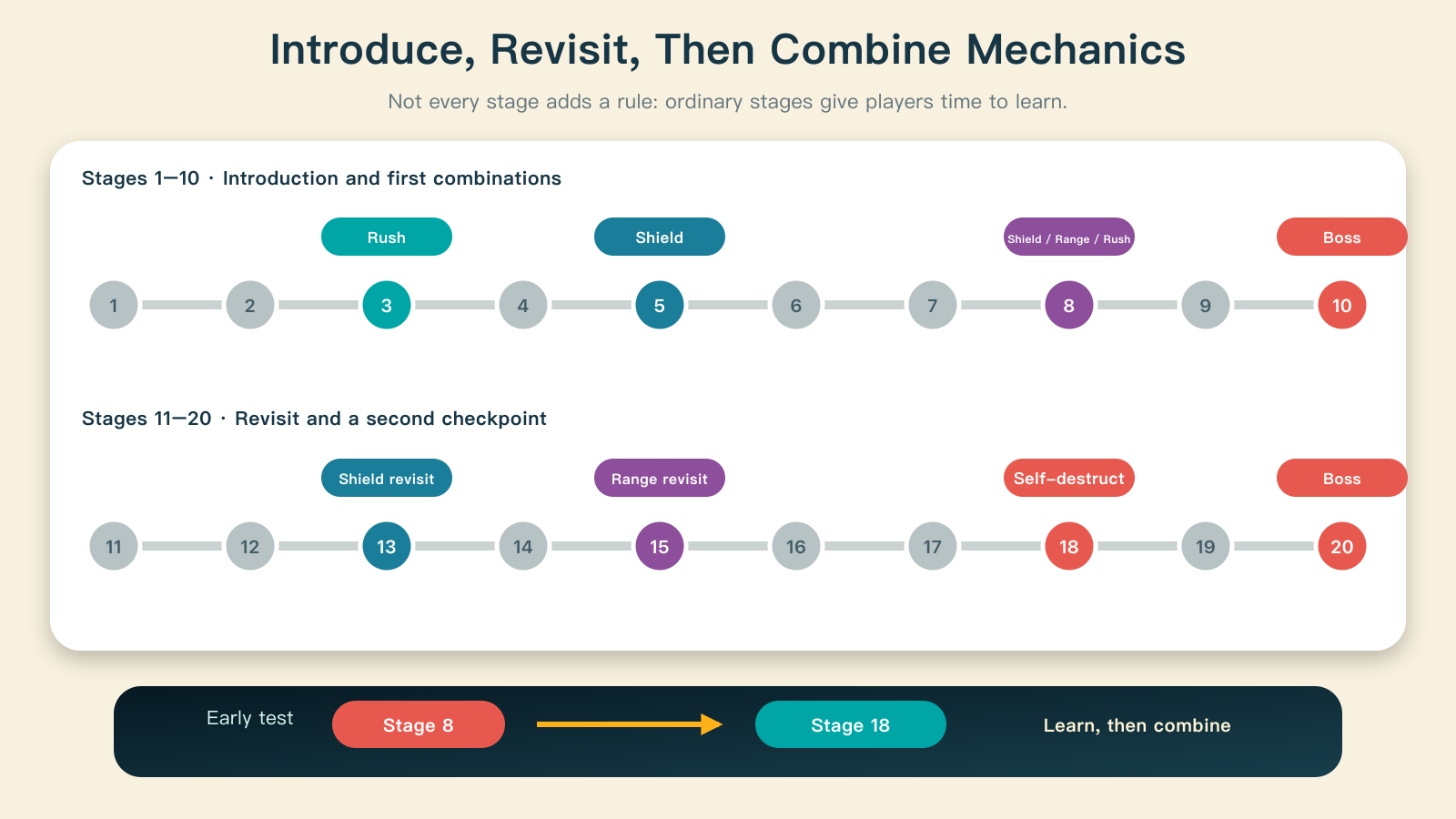
Self-destruct had worked mechanically at Stage 8, but competed with other unfamiliar information. Moving its first appearance later separated learning from combination. Designing a mechanic includes deciding when the player pays the cost of understanding it.
Warnings were part of that design. Waves and elites entered a warning queue; bosses had their own title and about three seconds of preparation time. A recognizable advance signal made the threat something the player could respond to.
A boss is an explicit combination
The Stage 10 boss arrived at 96.5 seconds, using a tank with health boost level 7, attack boost level 2, defensive shield level 2, extended range level 2, and movement slow level 6. No additional invisible boss multiplier doubled its statistics.
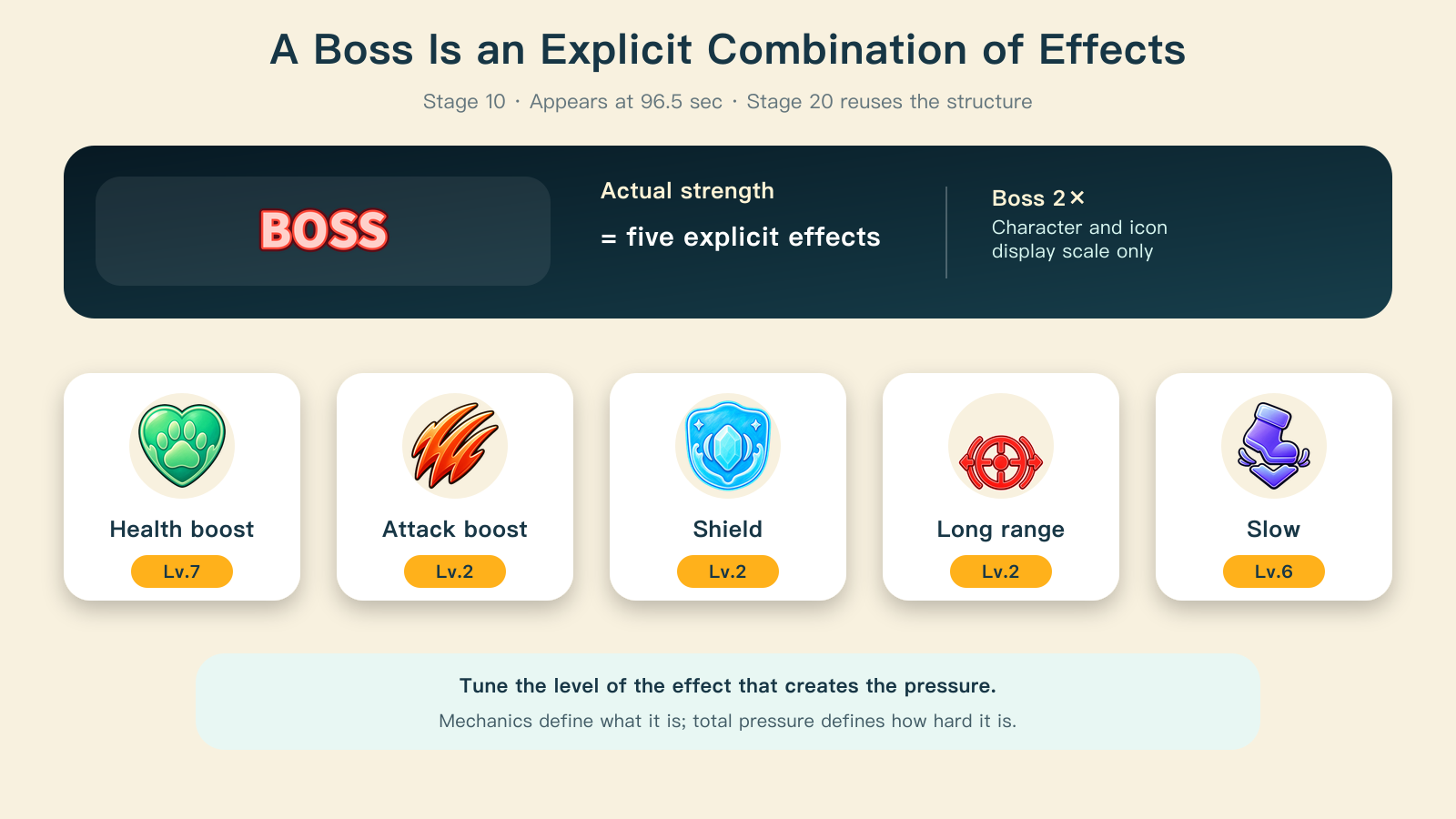
The larger presentation identified a major target. The effects supplied the actual behavior: more health, slower movement, a shield, and changes to range and attack. Excessive pressure could be traced to an individual effect level.
Stage 20 reused that structure while its overall configuration determined the encounter's pressure. The mechanic described what the enemy was; the balance layer determined how demanding this appearance would be. Both needed checking without becoming an unexplained combined multiplier.
Items are optional interventions
The five battle items restored 500 base health, healed all summoned allies, froze all enemies for 10 seconds, dealt 200 damage to all enemies with a 3-second stun, or doubled energy recovery for 30 seconds.
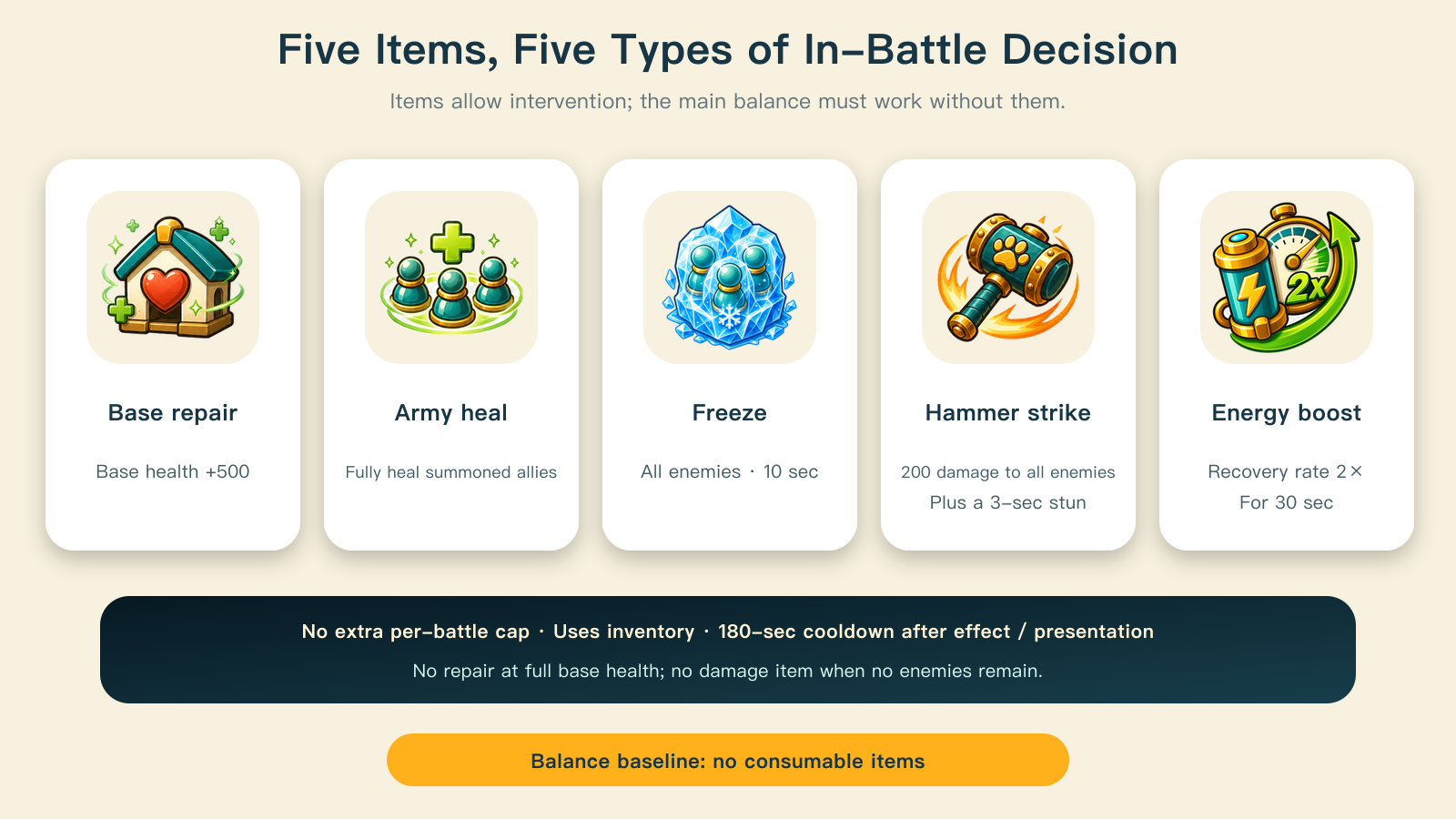
There was no additional per-battle use cap, but inventory still decreased. Another use required remaining stock and a 180-second cooldown after the full effect or presentation ended. A full-health base could not waste a repair item, and an empty battlefield could not consume an enemy-damage item without a living target.
Items were excluded from the formal balance baseline. They offered strategic intervention in danger, rather than compensating for an unbalanced campaign. Otherwise every failure could be blamed on insufficient inventory, concealing the actual pressure problem.
Defeat must leave useful information
Learning a mechanic requires attempts, including failures. The previous article explained reward settlement. Here its role was to return controlled growth resources based on real progress, giving the player another upgrade decision and attempt.
That income could not make defeat more efficient than victory or leave the player trapped below an upgrade threshold. Results and records also needed to reveal the pressure that caused the failure: neglected ranged enemies, self-destruct near a packed front line, or a poorly timed item. Information and a further choice made defeat more useful than a one-off punishment.
What do the human and AI each do?
The human defines the decision a mechanic should change: signals, reaction time, spacing between learning and combinations, and the boundary between a strategic aid and a mandatory consumable. They playtest clarity, satisfaction, and fatigue from consecutive pressure peaks.
AI can enumerate target-switch conditions, inspect effect levels and icons, inspect scheduled appearances, verify the absence of hidden boss multipliers, and check item targets, cooldowns, and unavailable states. Repeating the same scoped checks after revisions helps identify a broken causal chain.
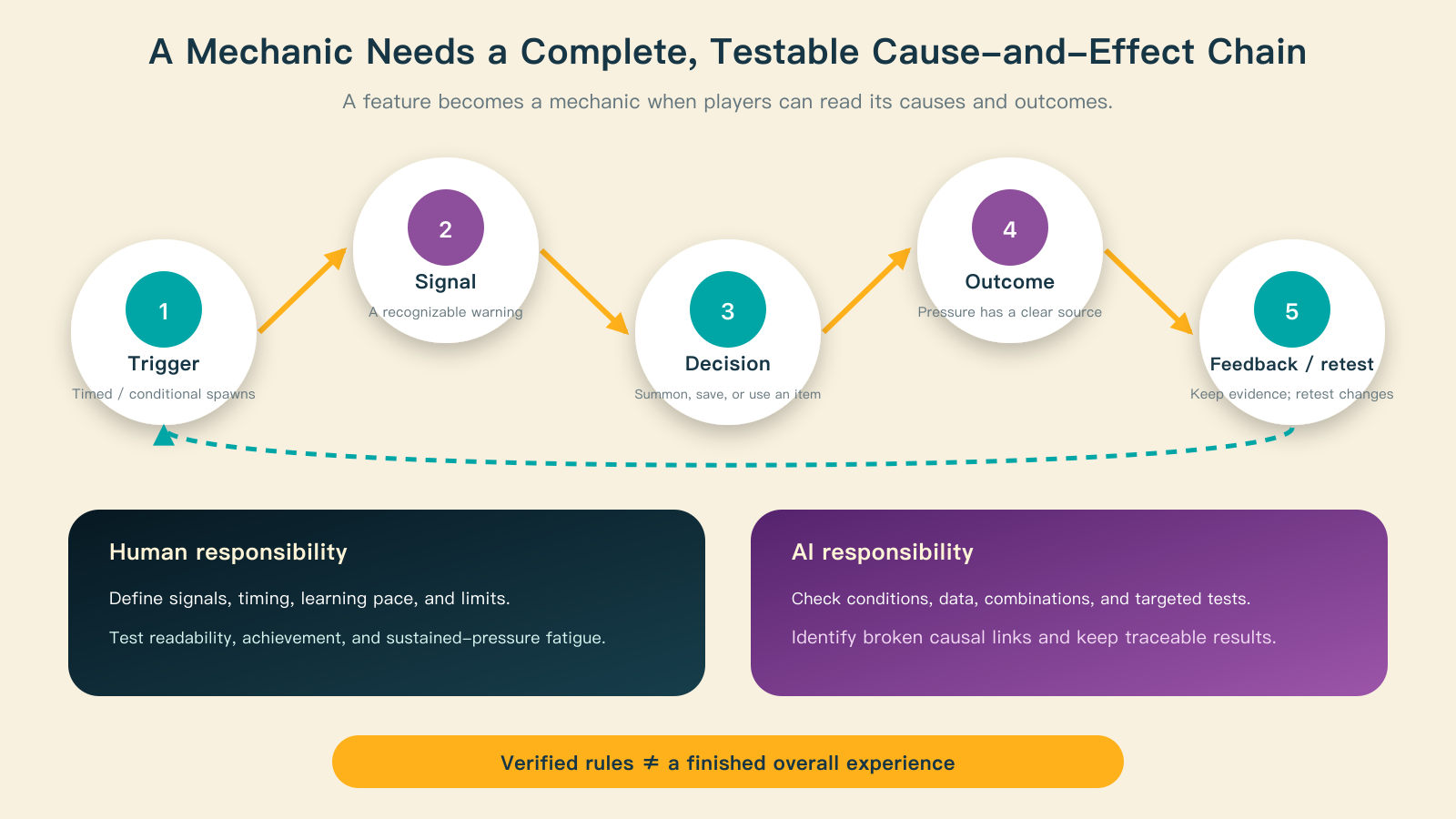
At the evidence cutoff, targeting and naming could be verified separately, but the full battle regression was still blocked by existing tutorial and warning assertions. The presence of mechanics in code did not mean the overall battle experience had passed every check.
Where to start
Choose one ordinary unit and name the additional decision it should create. Add stable targeting, a recognizable visual sign, an advance warning, and an understandable failure outcome. Introduce it alone, revisit it, then combine it with other mechanics.
Keep a path without temporary items. If a mechanic can only be bypassed with consumables, examine timing, signals, strength, and counterplay before blaming the player's stock. Make the cause and effect understandable before making it harder.